

World War II played a crucial role in the development of social security in Western Europe. Social security became an important part of the Allies’ vision for the organization of post-war society. The driving factors were unmistakably the experience of the crisis of the 1930s and the fear of post-war destabilization, reinforced by the popularity of the Communist resistance. And, last but not least, the concrete experience of the solidarity of the war years also made these post-war social initiatives more acceptable and even self-evident.
But the promise of a new social approach also became an ideological weapon in the struggle. This was certainly the case in Great Britain, where the British government appointed a Commission in June 1941 to review existing social insurance and related services and to make recommendations for rationalization and simplification. Sir William Beveridge, an economist and social liberal reformer, was chairman of the Committee.
In 1942, Beveridge proposed, in what soon became known as the Beveridge report, the introduction of a universal system of social insurance that would insure all inhabitants of the country against poverty. However, the report went further. It offered a comprehensive strategy to fight what it considered to be society’s “five giant evils”: want, disease, squalor, idleness and ignorance, “from the cradle to the grave”. Thus, it provided the foundation for the British welfare state.
The “welfare state” became the “new Jerusalem”, an ideal to strive for, an alternative for the Nazi’s “warfare state”. The report thus received a huge response that transcended national borders. It even went so far that copies of translated editions of the report were airdropped over the occupied territories.
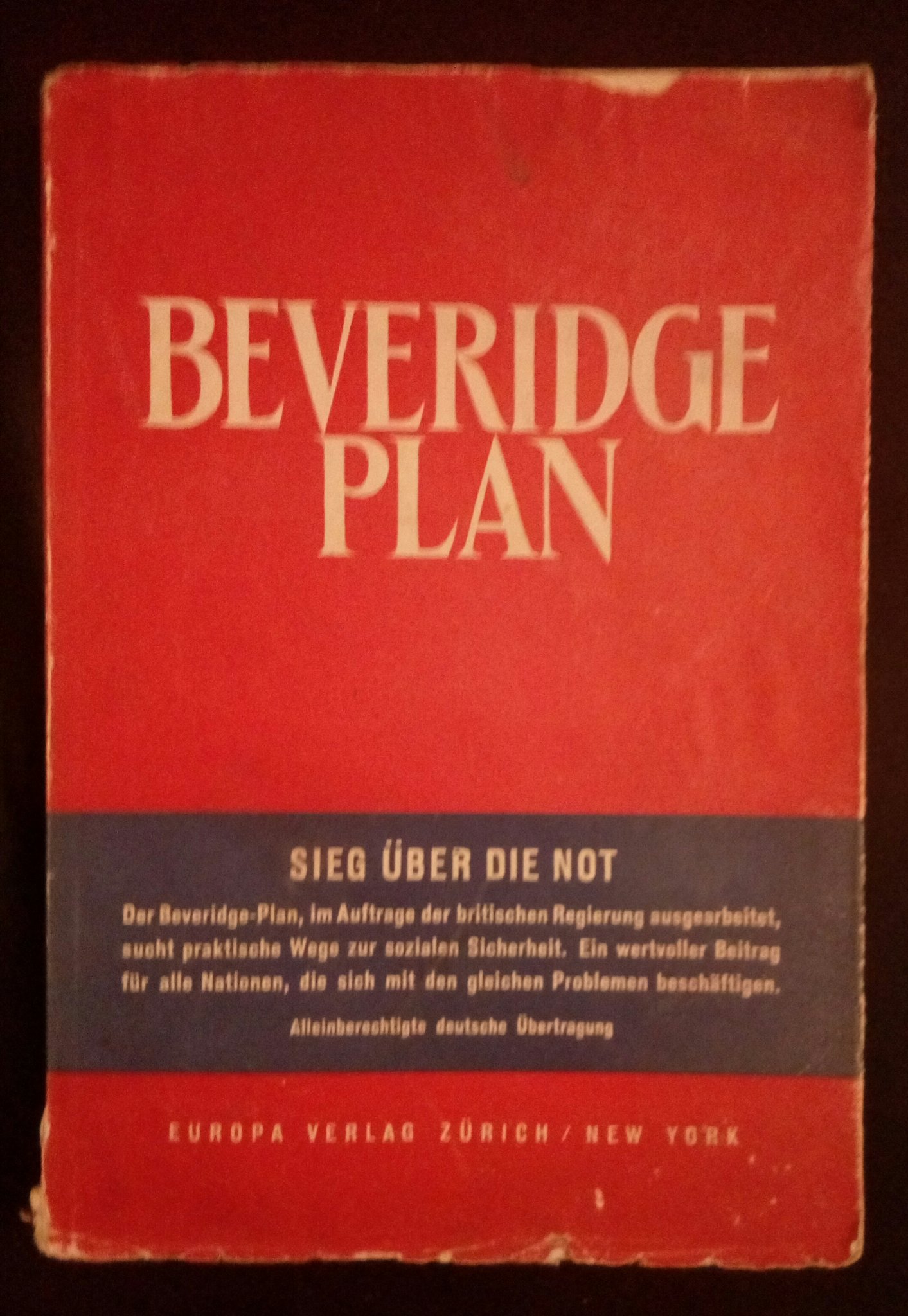
A German Translation of the Beveridge Report published in Switzerland in 1943.
In February 2018 the London School of Economics organised a “Beveridge 2.0” Festival, to honour its former director. It was a series of lectures exploring today’s “Five Giants”: the challenge of poverty, health and social care, education & skills, housing & urbanisation, and the future of work. The Beveridge 2.0 theme ran throughout the academic year 2017-18, informing how LSE shares its research and its societal impact. For more information: http://www.lse.ac.uk/Events/LSE-Festival/Beveridge
Other countries did not stay behind. In fact, in Belgium, Henri Fuss, the Director General of the Belgian Ministry of Labour and Social Affairs, dismissed from office by the German occupatier, tried to set up a consultative committee as early as 1940. He found willing discussion partners with the employers of Fabrimetal (now Agoria), in particular Paul Goldschmidt-Clermont and Georges Velter. The Belgian workers were represented by Henri Pauwels, chairman of the General Christian Trade Union Confederation, Arthur Jauniaux, the founder of the National Association of Socialist Mutualities, Joseph Bondas, general secretary of the Socialist Trade Union (CGTB), and Léon Delsinne, also of the CGTB. After his departure to London, Bondas was replaced by Hubert Lapaille until the latter was picked up and deported by the Gestapo. Later Louis Major and Achille Van Acker also joined the group. Alexandre Galopis, governor of the Societé Générale, also took part in the meetings, but was shot down by Rexists. In addition to Fuss himself, there was also Gaston Grignard, the director general of the “Office national du placement et du chômage”, like Fuss dismissed from his office by the German occupier. Fuss became chairman-rapporteur, according to him because of his “imposed leisure” (Fuss, 1956: 2).
On October 17, 1941, before the publication of the Beveridge report, this clandestine and informal committee started its proceedings. The committee did not have an official name, but is now simply known as the “committee of employees and employers”. The committee consisted of officials, employers and trade unionists who, even before the war, strongly believed in the power of social dialogue and in the need to strengthen social policy. The committee usually met on a weekly basis. The committee worked in a paritarian spirit “since these works could not lead to a positive result if not by the agreement of all” (Fuss, 1956: 2). According to Fuss, there was never a vote, not even on the procedures.
The first meeting of the social consultation took place on October 17, 1941. The meetings took place on a weekly basis, usually every Friday, and initially at various locations. One of these locations was Paul Goldschmidt-Clermont’s country retreat in Ohain, near Waterloo, where a memorial plaque reminds us of this period. But ultimately, Georges Velter offers them shelter in a small room of Fabrimetal, in the Lakenweverstraat 17-19-21-21C in Brussels (Ixelles), where the European Defense Agency is currently situated.
Interview with Claire, Paul Goldschmidt-Clermont’s daugther: https://www.tvcom.be/video/culture/9-reunion-secrete-a-ohain_4818_302.html
Their clandestine discussions dealt with a multitude of themes. Initially, the discussions focused primarily on the principles and methods of social dialogue. Only in 1943 they put “the fundamental reform of social security” on the agenda (Goldschmidt-Clermont, 1965). The negotiators did not see their social security project as an end point. It was particularly important for them to deal with urgent matters after the war, such as the drastic increase in some benefits, in order to meet the needs and aspirations of the population. So they had to act with a sense of urgency and the circumstances certainly did not simplify their work (technically anyway, because politically their relative isolation was probably helpful). Their ideas were therefore pragmatic and based on the pre-war arrangements. In addition to their drive, this pragmatism will distinguish their proposals from other wartime initiatives. The experience of Henri Fuss as an ILO unemployment expert undoubtedly played an important role as well.
On April 20th 1944 a social pact is signed by the negotiators. Achille Van Acker and Louis Major were still unable to sign the agreement on behalf of the socialist labour union. That is why it was called the “draft social solidarity agreement” instead (Fuss, 1956: 9). In May 1944 ) the draft text is sent to London through the clandestine Gilles Committee and the Clarence intelligence service, where the document arrived in July 1944 at the latest. However, the government in exile will not respond.

In the meantime, the members of the committee had great difficulty selling the proposals to their organisations. Paul Goldschmidt-Clermont and Georges Velter reiterated that « there can be no question of touching the text of the Social Solidarity Pact, otherwise we will blow everything up” (Van Themsche, 1994, p. 63). On August 11, 1944, negotiator Henri Pauwels writes a letter to Cardinal Van Roey to draw attention to the importance of the “draft social solidarity agreement” and the need to implement these proposals before the end of hostilities to avoid that the land is plunged into chaos, which would play into the hands of extremists and “troublemakers” (Fonds Hoyois, Arca, Louvain-la-Neuve).
On October 14th, 1944, the Nazi’s V-weapons were terrorizing the region of Antwerp that day, a National Labor Conference was organized under the chairmanship of Prime Minister Hubert Pierlot. However, the “draft agreement” is not on the agenda. They even wanted to conclude the conference after an explanation by Camille Gutt, the finance minister. The bewildered social partners request a suspension of the session to remind the prime minister of the existence of the “draft agreement”. Pierlot seems completely taken by surprise, but agrees. At 5 pm it is finally decided to include the “draft agreement” in the resolutions of the National Labor Conference. The “draft agreement” is thus rising out of the clandestinity. From then on it goes remarkably fast.
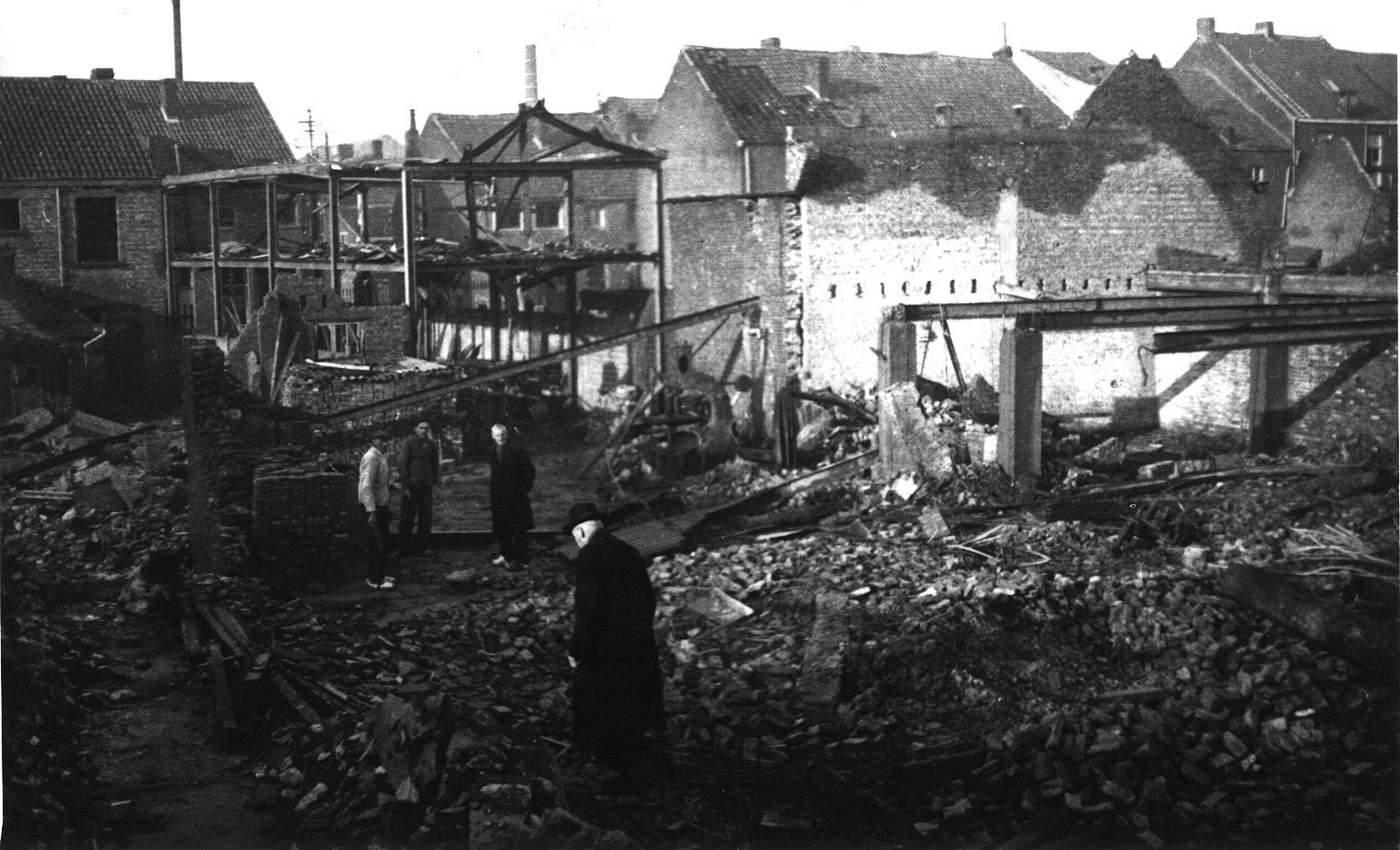
On December 28th, 1944, the new Minister of Labor and Social Security, Achille Van Acker, one of the clandestine negotiators, presented the “Social Security Act for Workers” to Prince-regent Charles. The Act was signed and on December 30th, 1944, it was published in Belgium’s State Bulletin. The Social Security Act reflected the “draft agreement”, which should come as no surprise since it was mainly drafted by Henri Fuss. On the occasion of the twenty-fifth anniversary of social security, Van Acker reflected the atmosphere of those days in his speech: “I remember very well that the members of my cabinet; the administration and myself, had spent part of the night in our coats to protect us from the cold, to ensure that the Act would be published before January 1945 ”(1970: 351).
Despite its international resonance, the Beveridge report,with its emphasis on publicly organized social security with the primary objectiveof preventing poverty, had little impact on the system proposed by the Belgian negotiators.Moreover, the negotiators afterwards felt it was necessary to explicitlydistance themselves from the British “Beveridge model”. According to Fuss, theBeveridge report was not yet known to the discussion partners. According tohim, their realization was “authentiquement belge” and “une œuvre de grosbon-sens” (Fuss, 1956: 2). Their proposals were certainly rooted in thepre-war Belgian tradition, characterized by a very important role of socialorganizations, such as trade unions and mutual insurance companies, in thedevelopment of social policy.
I conclude with a concise text that I found in the personalarchive of Henri Fuss. The French-language text, presented here in a translatedversion, appeared on November 9, 1944 in the clandestine magazine Alerte and wassigned by “Paul Dominique”, a “nom de plume” by Henri Fuss.It appeared shortly after the liberation and before the signing of the SocialSecurity Act. It gives a good picture of the atmosphere of those days, as wellas the motives of the authors of the social security project and, of course, inthe first place that of Henri Fuss himself:
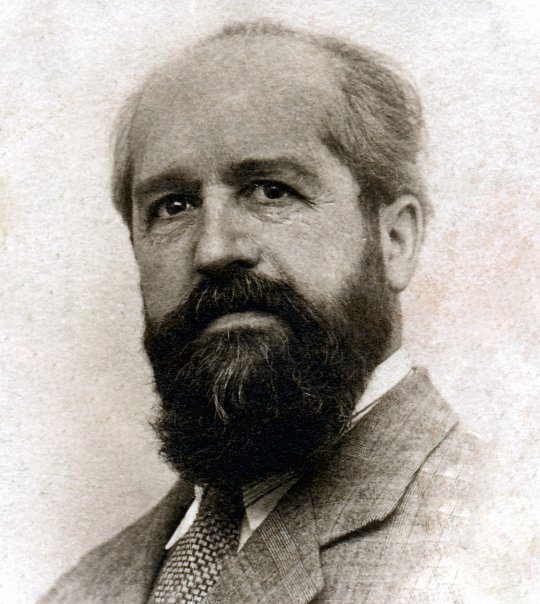
Henri Fuss (1882-1964), motivated by a quest for “human perfection and justice”, had succeeded in convincing his partners during the dark years of war of the “noble cause and necessity of an agreement on social solidarity” (Velter, 1964).
Social security – a fundamental basis for peace
Two major certaintiesare required for peace: international security and social security.
International security can only be achieved if all states comply with international – democratic – legislation, and when sanction mechanisms are applied whenever a state – no matter how large or how small – commits the aberration of violating it. The problem here is that a law should not only be written, but also needs to be interpreted. Two conflicting interpretations are sufficient to play out nationalities and groups against each other. In these circumstances, a simple international police action by the United Nations against a delinquent state, that should normally be unable to form a serious resistance, becomes impossible, and as a result the world may be confronted with a new world war.
National legislation is enough for the municipal police and the national police to arrest criminals, even when they act in gangs. But during a civil war, when a population is radically divided into groups with completely opposing views on the basic principles of law and when the national institutions are unable to reconcile these contradictions, the police and the central government are also powerless. And that is much more clearly the case in international relations.
Throughout history, but especially in recent decades, we have learned that war imperialism often has its cause – we do not speak of justification – in a general impoverishment of the population. When power hungry politicians, bankers and industrialists craving for new markets, do not shy away from launching a criminal war of conquest, an impoverished population is usually an easy prey. “You suffer from having to live on a territory that is too small and populated with too many people. You are hungry, while neighboring countries have flourishing wheat fields. You suffer because you do not have access to the resources that foreign countries have. “You suffer from the lack of outlets for the products of our industry. It is the stranger that withholds them from us. The stranger is an enemy. You will no longer suffer when we have conquered our living space. You are a great people, but the victim of the stranger. The war brings salvation. “
This terribledeception, which stirs up a people armed to the teeth against their neighborsto eventually bring it to mass murder, has no hold on a happy people. Happypeople are peaceful. The war is so far from their thoughts that they must beattacked effectively before they actually start preparing their defense.
Aggression and thedesire for war will disappear when no more people will be victims of poverty orfear of poverty. That is why social security, the instrument of social justice,forms a fundamental basis for peace. International security remains precariousas long as there is no adequate social security.
After the war has beenwon, a social security system must therefore be introduced in all countries ofthe world in order to also win peace. That is the price that must be paid forpeace between classes and for peace between nations. A low price, by the way,because social security does not diminish the patrimony of any nation. On thecontrary, it consolidates national patrimony by helping to distribute theincome of the national economy more fairly, that is to say, according to needs.What we could not allow is for a nation to compete with other nations forunfair competition by including as little as possible in the cost of its productsthe immediate burden that this redistribution imposes on businesses. Socialsecurity must become an international obligation.
Belgium is not lagging behind. During the occupation, prominent figures from the world of employers and workers regularly met in secret. Under the title “Draft agreement for social solidarity”, they laid the foundations for a social security policy that the government had to master. The emergency measures that have already been taken at the initiative of Minister of labour Van Acker are merely precursors of the global plan on which the government is working and for which, in order to achieve this quickly, he has asked Parliament to grant him special powers of a legislative nature. The planned Act makes it possible to impose on employees and their employers contributions that provide a financial guarantee for the social security of the employees, namely: an old-age pension equal to half the most common wage, medical care and medicines for the whole family in the event of sickness, disability and invalidity benefits, maternity leave benefits for working women, funeral expenses, support benefits in the event of involuntary unemployment due to lack of work, a higher family allowance than the one previously paid special for the first child.
All this, of course,only applies to employees. Should it not be considered to also guarantee thesocial security of the self-employed, the traders and the craftsmen?Undeniably. We believe that the Minister for Labor and Social Security haspresented the problem for study and that we can expect a solution soon.
Apart from the manyquestions concerning financing, control, professional organization, andnational solidarity, it is first and foremost a matter of making the economic strongestsupport the economic weak.
Social justice isheading in the right direction. By striving for social justice, Belgium willcontribute to peace, just as the country contributed to the victory, for whichso many of her sons gave their lives.
Paul Dominique (alias of Henri Fuss)
 Social Security: The Story of an Idea(l)