

During the 19th century, mutualism and various forms of self-help were widely considered to be the best way to deal with the “social question”, the precarity of the industrialized working class. It was a vision that was for a long-time shared by liberals, catholics and other religiously inspired politicians, and even socialists.
In Germany, however, social reformers from the Vereins für Socialpolitik (Association for Social Policy), developed the viewpoint that the government should become more involved. The Vereins für Socialpolitik was founded in 1873 as an academic circle that sought to find a bridge between the Manchester Liberals and the social-revolutionary ideas of emerging socialism. They organized annual general assemblies and presented the conclusions of their deliberations as petitions to the Reichstag, the German parliament. In 1874 they deliberated on the issue of mandatory versus voluntary old-age and invalidity insurance and they concluded in favour of mandatory solutions.
Germany’s Chancellor, Otto von Bismarck, who saw the social question as an internal threat that needed to be addressed, initially wavered between the two positions before deciding in favor of state intervention. An important factor in his decision was the Vereins’ view that mutuals and other voluntary arrangements by themselves were not up to the task of solving the social question. But there was another motive. Bismarck hoped, with the help of a state social policy, to bind the workers to the state, thus enabling him to reduce the repression of the socialist movement. In his own words, later in life: „Mein Gedanke war, die arbeitenden Klassen zu gewinnen, oder soll ich sagen zu bestechen, den Staat als soziale Einrichtung anzusehen, die ihretwegen besteht und für ihr Wohl sorgen möchte“ (“My idea was to win the working classes, or should I say bribe, to regard the state as a social institution that insists on its behalf and cares for its well-being”). However, Bismarck’s motivation for the introduction of social insurance was multi-layered, as was the man himself. Whatever his main motivation was, he clearly took a personal interest in the matter and decided to take personally charge of the development and implementation of Germany’s Arbeiterversicherung (workingman’s insurance).
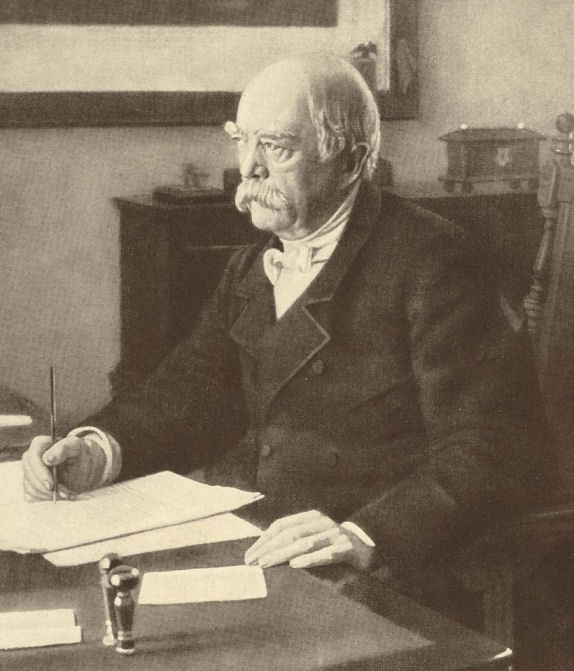
Otto von Bismarck-Schönhausen, Prussia’s and Germany’s Chancellor from 1862 tot 1890
Bismarck’s original concept provided for a compulsory social insurance system that was organized by the state and financed out of general taxation. However, during his consultations, civil servants, political parties and interest groups made considerable modifications to his original designs. The result was what we now know as Bismarckian social insurance, namely mandatory social insurance schemes financed by mandatory social contributions, providing for wage-related benefits administered through jointly managed mutual funds and local governments services.
In an Imperial message, read to the Reichstag by Bismarck on November 17, 1881, the Emperor announced that his government would take the initiative to provide a “new and lasting guarantee” that would bring about “domestic peace” by “offering those who suffer, the assistance to which they are entitled”. He immediately announced a series of legislative initiatives, including “a project of a worker’s insurance against accidents at work”. Mandatory health insurance was introduced in 1883 and was followed a year later by the anounced insurance against accidents at work. Mandatory invalidity and old-age insurance took a little longer and was only introduced in 1889. Old-age insurance was seen as the capstone of invalidity insurance, because few reached the legal retirement age of Bismarck’s old-age insurance, which was initially set at 70 years but was later changed to 65 years. In 1891, there were merely 120,000 retired elderly throughout the German Empire.

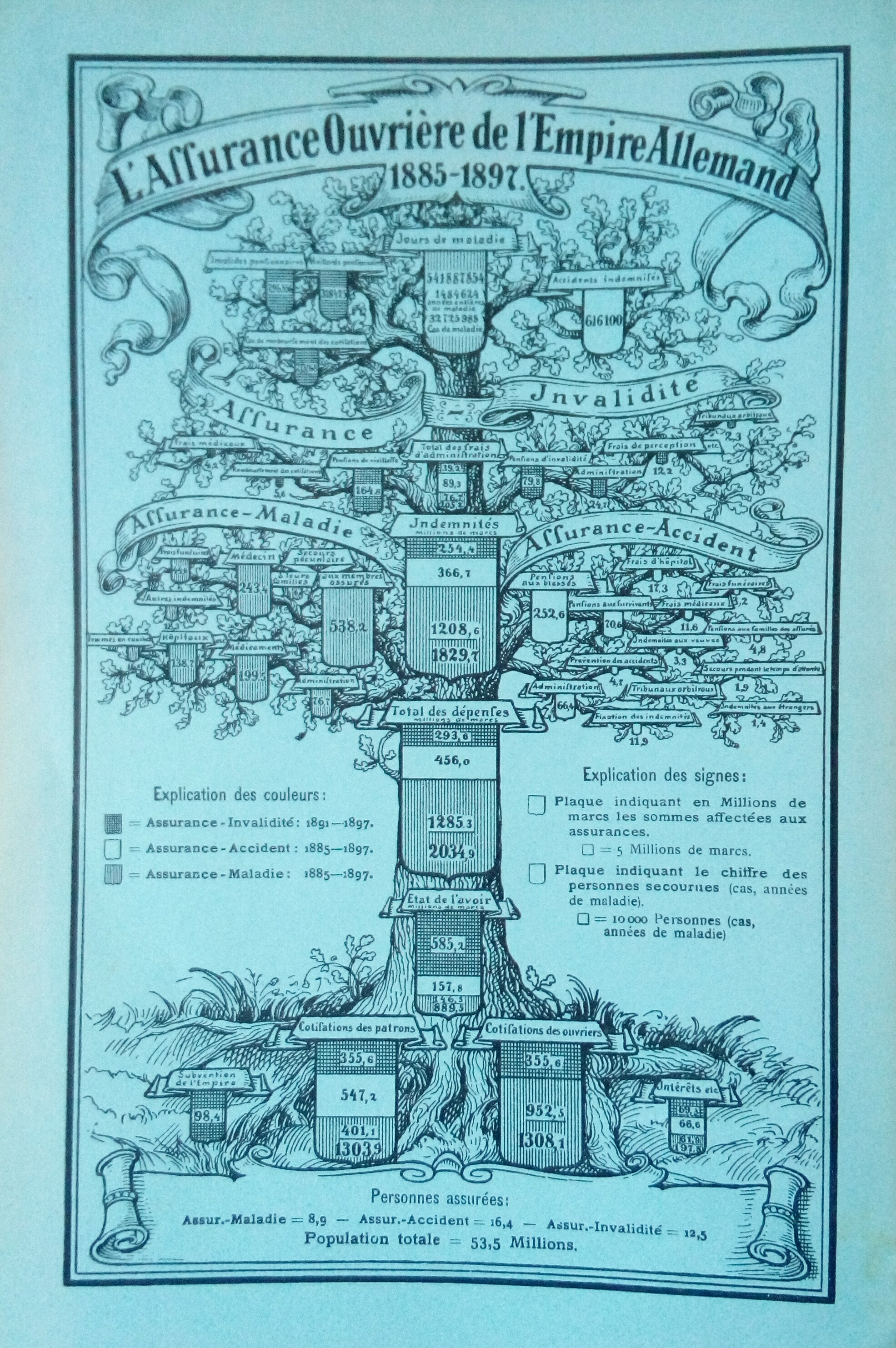
Thus, a comprehensive, compulsory and state-guaranteed social insurance system was introduced for the first time. Of course, there was contemporary criticism of this “Zwangversicherung”, but compulsory insurance was considered necessary to insure even those who could not get protection through voluntary private insurance, for example because of their low income or high risk. According to Bismarck, this was the only way to resolve the social question. Even so, coverage was initially more limited than the idea of a compulsory system would seem to imply. In 1885, for example, only 4.3 million people in the German Empire (about a quarter of workers) were covered by mandatory health insurance, although by 1898 their number had already risen to 9 million (56% of workers). White-collar workers, for instance, were initially excluded.
The voice of Otto von Bismarck, as registered by a representative of the Edison-Company in his home on October 7th, 1889 : https://www.nps.gov/media/video/view.htm?id=2C341906-155D-451F-6779B4CF633B8F7E
Although he was personally deeply involved in the development of social insurance, Bismarck would later distance himself from his historical merit. In old age, long after he had been dismissed, he declared that he thought the social insurance legislation had got out of hand. Nevertheless, his initiative to introduce mandatory social insurance had a huge resonance in the surrounding European countries. Not in the least because the German government published brochures in various languages to inform interested parties abroad. Officials in Germany were keen to demonstrate that social insurance was not only a great succes, but also that the German State was benevolent, and fair to all members of society, employers and workers alike. Visual aids were used in exhibits, which toured international events such as the 1900 Exposition Universelle in Paris. Similar exhibits also toured German schools as a means to educate citizens in the benefits of social insurance.
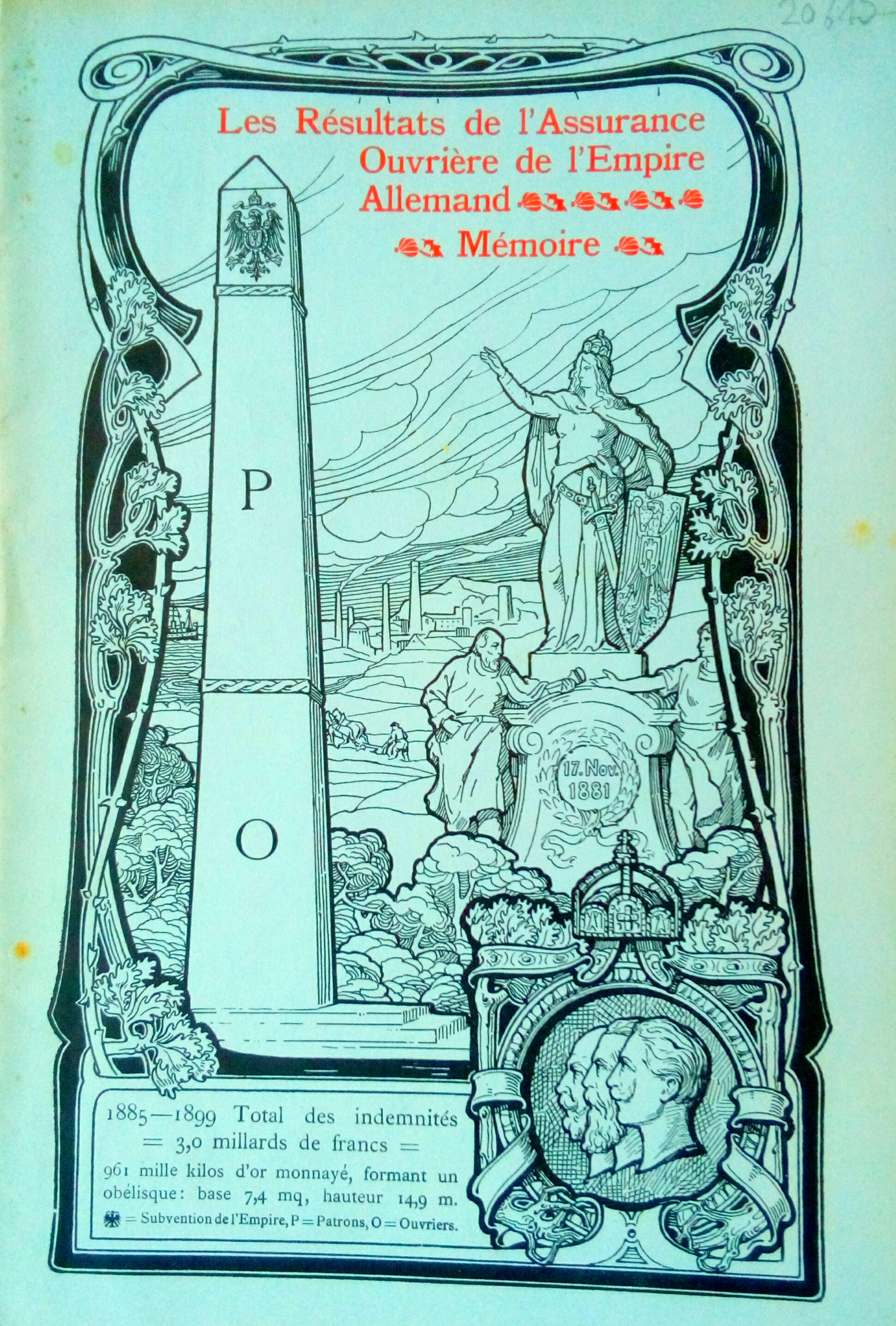
However, mandatory social insurance remained controversial in many countries. Some governments, for instance the French government, rejected the German example, claiming that compulsion could only work in a German context. Besides the contemporary French-German antagonism, the presence of a powerful mutualist movement in France no doubt played a role. However, France was not an exception. In Britain and Italy “statalisation” was still a taboo. During the 1889 Exposition Universelle in Paris, boycotted by Germany, the first congrès international de la Mutualité was organized. Jules Arboux, Secretary General of the French Ligue nationale de la prévoyance et de la Mutualité was the rapporteur of a discussion group addressing the following question: Is it necessary to continue to defend a system of individual and free pensions, in short, the principle of liberty, or else, to draw inspiration from the German example, and promote a compulsory system? Not surprisingly, the rapporteur argued against compulsion. More interestingly, he also drew a distinction between a group of countries like Germany and Austria-Hungary, in favor of a compulsory social insurance system, and a second group: Belgium, the United States, France, Great Britain, Holland, Italy, and Switzerland, where on the contrary a system of foresight, free initiative and mutualism played a predominant role. An intermediate group of Denmark, Norway, Russia and Sweden, tried to strike a balance between the two visions.
Today, the debate on the voluntary or compulsory nature of social insurance is still very much alive, even though most European countries have implemented comprehensive systems of mandatory social insurance. At least as far as salaried workers are concerned, because the self-employed are often covered on a voluntary basis. Voluntary participation to social insurance schemes might be politically less controversial, but there are many disadvantages related to voluntary participation. It reduces insurance pooling and only those that can afford it and/or those confronted with a relatively high risk might be tempted to opt in.
Thus, I tend to agree with Rahlenbeck, a Belgian who already back in 1895 pleaded eloquently for the introduction of compulsory social insurance, because of the limitations of voluntary insurance: Les raisons profondes, indestructibles: l’instabilité des salaires, la difficulté que l’ouvrier d’ordre inférieur, pour lequel est le plus nécessaire, éprouve à comprendre la prévoyance dont les bienfaits ne sont pas immédiatement tangibles […] L’assurance ouvrière sera obligatoire ou elle ne sera pas, tel est l’axiome certain qui résulte invinciblement de toute étude approfondie et désintéressé de ce grave problème, l’un de ceux qui touche le plus directement à la question sociale (“The deep, indestructible reasons: the instability of wages, the difficulty that the lower-order worker, for whom it is most needed, fails to understand foresight, the benefits of which are not immediately tangible […] Insurance for the working class will be obligatory or it will not be, such is the certain axiom which inevitably results from any thorough and disinterested study of this serious problem, one of those which touches most directly on the social question “).
 Social Security: The Story of an Idea(l)