

2019 is a year of celebration for the International Labour Organisation (ILO), because this UN Agency celebrates its 100th anniversary. The ILO is the only tripartite UN Agency. The formal gates of the ILO building even require three keys to open, symbolizing the equal contributions of the three constituent groups: governments, employers and workers. The ILO brings the governments, employers and workers of 187 member states together to strengthen dialogue on work-related issues, set labour standards, develop policies and devise programmes promoting decent work for all women and men. The ILO has been doing this since 1919.

For the ILO was founded in the wake of World War I, as part of the Treaty of Versailles, to pursue a vision based on the premise that universal, lasting peace can be established only if it is based on social justice. When, in 1926, the ILO moved into its first purpose-built offices on the shore of Lake Geneva, the foundation stone was engraved with the Latin phrase, Si vis pacem, cole justiciam (If you desire peace, cultivate justice). A society that provides security for its citizens protects them not only from war and disease, but also from the insecurities related to making a living through work. So, the ILO’s takes its main objective to promote labour standards, including on social security, very seriously.
The ILO’s centenary is an opportunity to celebrate the ILO’s achievements, not only in the domain of work, but also in that of social protection. The ILO has had, and still has, an important impact on the development of social security worldwide. Despite her age, her influence seems to have even increased in recent years.
The promotion of social security is in the genetic code of the ILO. The organisation was strongly influenced by an international movement that, even before the first world war, worked to promote social insurance programmes. An example is the Permanent International Committee for Social Insurance (‘Comité permanent international des Assurances sociales’ or CPIAS), based in Bern, Switzerland, that was founded during the 1889 Paris Exposition Universelle. The members of this movement were academics, politicians, civil servants, and other experts. They regularly met each other during international conferences organised by the committee to discuss best practices and innovative ideas. Many members of this committee later became technical advisors to the ILO.
Another important movement was the International Association on Unemployment (‘Association internationale pour la lutte contre le chômage’), based in Ghent – Belgium. The movement was created in 1910 by Louis Varlez, a Belgian social-liberal reformist and pioneer in the domain of unemployment insurance. On his initiative, the city of Ghent created an unemployment insurance fund. This unemployment fund was managed and partly funded by the labour unions, but subsidized by the city of Ghent. This system was widely followed in the world under the name of the “Ghent system”. Varlez became the first secretary general of the association and the French social-liberal reformer and prominent politician, Léon Bourgeois, its president. In 1920, Varlez became the first director of the ILO’s unemployment and migration department, while Bourgeois was elected first president of the League of Nations.
Another international association worth mentioning is the International Conference of National Associations of Mutual Benefit Societies and of Sickness Insurance Funds, founded in October 1927 in Brussels – Belgium. In 1936 the Association becomes the International Social Insurance Conference (CIMAS) and expands its admission criteria to include social insurance institutions responsible for administering disability, old age and survivors’ insurance. In 1947 a new Constitution is adopted, opening membership to government administered social security agencies. CIMAS officially changes its name to the International Social Security Association (ISSA). From the beginning ISSA worked very closely together with the ILO, functioning as a sort of technical think tank. Also the ISSA and the ILO often shared the same staff. ISSA is still very active, now bringing together more than 330 organizations in 158 countries. ISSA’s fifth World Social Security Forum (WSSF) will be held in Brussels from 14 to 18 October 2019. For more information: https://www.issa.int/en/wssf2019

From the start the ILO is very active in the domain of social security. For its deliberations on social security, the Internationa Labour Office, the administrative body of the ILO, established its own expert group, the Social Insurance Section, as early as 1921. The ILO’s tripartite structure often helped to shape debates and broker compromises on social policies before they entered the national realm. Thanks to these organisational specificities, and the directorship of the charismatic Albert Thomas, the ILO quickly became the epicentre for international debates on social policy. During the interbellum the ILO approved an incredibly wide variety of recommendations and conventions in the domain of social security:
- The Reciprocity of Treatment Recommendation, 1919 (No. 2);
- The Maternity Protection Convention, 1919 (No. 3);
- The Social Insurance (Agriculture) Recommendation, 1921 (No. 17);
- The Workmen’s Compensation (Agriculture) Convention, 1921 (No. 12);
- The Unemployment (Agriculture) Recommendation, 1921 (No. 11);
- The Maternity Protection (Agriculture) Recommendation, 1921 (No. 12);
- The Migration Statistics Recommendation, 1922 (No. 19);
- The Workmen’s Compensation Conventions (Accidents, Occupational Diseases) and Recommendations (Occupationale Diseases, Minimum Scale, Jurisidiction), 1925 (Nos. 17, 18, 24, 22, 23);
- The Migration (Protection of Females at Sea) Recommendation, 1926 (No. 26);
- The Inspection of Emigrants Convention, 1926 (No. 21);
- The Sickness Insurance Recommendation (No. 29) and Conventions (Agriculture & Industry), 1927 (Nos. 24 and 25);
- The Old-Age Insurance (Industry, Agriculture) Convention, 1933 (Nos. 35, 36);
- The Invalidity Insurance (Industry, Agriculture) Convention, 1933 (Nos. 37, 38) ;
- The Survivors’ Insurance (Industry, Agriculture) Convention, 1933 (Nos. 39, 40);
- The Invalidity, Old-Age and Survivors’ Insurance Recommendation, 1933 (No. 43);
- The Unemployment Provision Recommendation and Convention, 1934 (No. 44);
- The unemployment (Young Persons) Recommendation, 1935 (No. 45);
- The Maintenance of Migrants’ Pension Rights Convention, 1935 (No. 48)
- The Migration for Employment Recommendations and Convention, 1939 (Nos. 61, 62, 66)
The Second World War reinforced the view that the ILO’s mission for social justice is essential for the creation of post-war peace. On August 14th, 1941, the leaders of the United Kingdom and the United States drafted the Atlantic Charter, a pivotal policy statement identifying their goals for the post-war world. All the ‘Allies’ of World War II later confirmed it. The fifth clause of the Charter declared that they desired to bring about the fullest collaboration between all nations in the economic field with the object of securing, for all, improved labor standards, economic advancement and social security. Adherents of the Atlantic Charter signed the Declaration by United Nations on January 1st, 1942, which became the basis for the modern United Nations.
The Atlantic Charter provided a strong basis for the 1944 Declaration of Philadelphia, the declaration which restated the aims and principles of the International Labour Organisation (ILO), and which was adopted by the International Labour Conference on May 10th, 1944. In 1946, when the ILO’s constitution was being revised by the General Conference convened in Montreal, the Declaration of Philadelphia was annexed to the constitution and forms an integral part of it by Article 1. The Philadelphia Declaration specifies that the ILO should further “among the nations of the world” the “extension of social security measures to provide a basic income to all in need of such protection”. Three of the seven recommendations adopted by the conference, and four additional resolutions, dealt specifically with social security proposals.
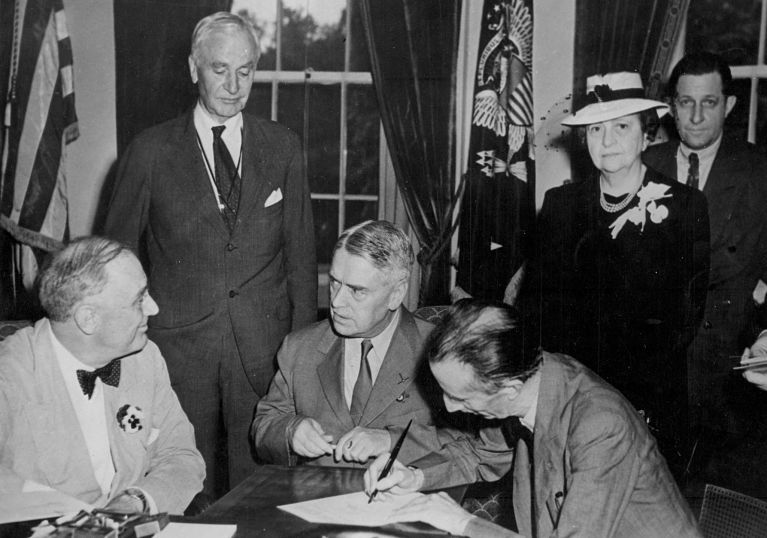
Edward J. Phelan signing the Declaration of Philadelphia at the White House in the presence of (left to right) President Franklin D. Roosevelt, Cordell Hull (US Secretary of State), Walter Nash (President of the 26th Session of the ILC), Frances Perkins (US Secretary of Labor) and Lindsay Rogers (ILO Assistant Director), Washington DC.
On May 12th the Income Security Recommendation (no. 67) was approved, followed on the same day by the Medial care Recommendation (no. 69). They envisage comprehensive social security systems and the extension of coverage to all and laid the foundations for Convention No. 102 (1952). A third recommendation adopted that day was related to the war time effort, namely the Social Security (Armed Forces) Recommendation (no. 68).
The Social Security (Minimum Standards) Convention, adopted in 1952 (No. 102), was a vital tool for the promotion of social security. It covers nine branches of social security and sets minimum standards for these nine branches. It is the flagship of all ILO social security Conventions, as it is the only international instrument, based on basic social security principles, that establishes worldwide-agreed minimum standards for all nine branches of social security. These nine branches are:
- medical care;
- sickness benefit;
- unemployment benefit;
- old-age benefit;
- employment injury benefit;
- family benefit;
- maternity benefit;
- invalidity benefit; and
- survivors’ benefit.
The minimum objectives of the Convention relate, for all the nine branches, to the percentage of the population protected by social security schemes, the level of the minimum benefit to be secured to protected persons, as well as to the conditions for entitlement and period of entitlement to benefits. Convention No. 102 does not prescribe how to reach these objectives but leaves certain flexibility to the member State. It requires that only three of these branches be ratified by Member states, which allows for the step-by-step extension of social security coverage by ratifying countries.
Furthermore, Convention No. 102 lays down that social security schemes be administered on a tripartite basis, which aims at guaranteeing and strengthening social dialogue between Governments, employers and workers. It is an up-to-date instrument and recognized by the 2011 International Labour Conference as a benchmark and reference in the gradual development of comprehensive social security coverage at the national level, Convention No. 102 has been ratified by 48 ILO Member States. However, a number of countries have ratified the European Code of Social Security, which was modelled on Convention No. 102 but provides higher benefit levels.
Other up-to-date Conventions and Recommendations, adopted after Convention No. 102 (1952), set out higher standards for particular branches of social security. Drawn up on the model of Convention No. 102, they offer a higher level of protection, both in terms of the population covered and of the level of benefits:
- The Equality of Treatment (Social Security) Convention, 1962 (No. 118) with regard to migrating nationals of Member for which the Convention is in force;
- The Employment Injury Benefits Conventionand Recommendation, 1964 (No. 121);
- The Invalidity, Old-Age and Survivors’ Benefits Convention and Recommendation, 1967 (No. 128);
- The Medical Care and Sickness Benefits Convention, 1969 (No. 130) and the Medical Care and Sickness Benefits Recommendation, 1969 (No. 134);
- The Maintenance of Social Security Rights Convention, 1982 (No. 157) and the Maintenance of Social Security Rights Recommendation, 1983 (No. 167), provide reinforced protection to migrant workers;
- The Employment Promotion and Protection against Unemployment Convention, 1988 (No. 168) and the Employment Promotion and Protection against Unemployment Recommendation, 1988 (No. 176);
- The Maternity Protection Convention, 2000, (No. 183) and the Maternity Protection Recommendation, 2000 (No. 191).
The new millennium brings a new elan. In 2012 the International Labour Conference adopted the Social Protection Floors Recommendation (No. 202). This Social Protection Floors Recommendation complements the existing Conventions and Recommendations and reaffirms that social security is a human right and a social and economic necessity. In particular, it assists member States in covering the unprotected, the poor and the most vulnerable, including workers in the informal economy and their families. It thereby aims at ensuring that all members of society enjoy at least a basic level of social security throughout their lives.
In order to ensure effective access to essential health care and basic income security throughout the life cycle, national social protection floors should comprise at least the following social security guarantees, as defined at the national level:
- access to essential health care, including maternity care;
- basic income security for children, providing access to nutrition, education, care and any other necessary goods and services;
- basic income security for persons in active age who are unable to earn sufficient income, in particular in cases of sickness, unemployment, maternity and disability;
- basic income security for older persons.
The Recommendation provides guidance to countries:
- in establishing and maintaining national social protection floors as a fundamental element of national social security systems;
- in implementing their floors within strategies for the extension of social security that progressively ensure higher levels of social security to as many people as possible, guided by ILO social security standards.
A commission led by Michelle Bachelet elaborated the proposal, defining a basic floor as “an integrated set of social policies designed to guarantee income security and access to essential social services for all, paying particular attention to vulnerable groups and protecting andempowering people across the life cycle” (Bachelet 2011, p. 23).
However, the Social Protection Floors Recommendation promotes a “stepping stone” strategy. It sees social policy as a matter of right, calling for “the extension of social security that progressively ensure[s] higher levels of social security to as many people as possible” (ILO 2012, Article 1b). It proposes to begin with essential services and transfers for the poor.
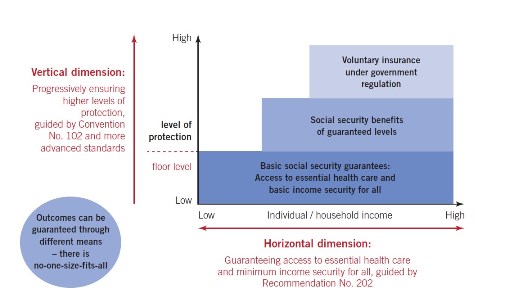
The Social Protection Floors Recommendation created a new momentum for the expansion of social protection throughout the world. By 2012, it had gained the support of the United Nations, the World Bank, the Group of 20 and many international non-governmental organizations. The rationale of the social protection floor is also behind the Sustainable Development Goals (SDGs) approved in 2015. The ultimate objective of the goals is to “build on the success of the Millennium Development Goals (MDGs) and aim to go further to end all forms of poverty”.
In September 2016 the Global Partnership for Universal Social Protection was launched by the UN General Assembly. The Global Partnership is an unprecedented effort to roll out universal social protection in countries all around the world. aiming to make pensions, maternity, disability and child benefits, among others, available to all persons, closing the gap for hundreds of millions currently unprotected worldwide.
Under the co-leadership of the ILO and the World Bank, the Global Partnership Universal Social Protection 2030 (USP2030) works together to increase the number of countries that provide universal social protection, supporting countries to design and implement universal and sustainable social protection systems, in line with the 2030 agenda for sustainable development, and in particular target 1.3 of the sustainable development goals (SDG 1.3). Actions include:
- coordinating country support to strengthen national social protection systems,
- knowledge development to document country experience and provide evidence on financing options and advocacy for integrating universal social protection.
For more info: https://www.usp2030.org/gimi/USP2030.action
Thus, the ILO still actively promotes policies and provides assistance to countries to help extend adequate levels of social protection to all members of society. In fact, the ILO’s influence in this policy domain is stronger than ever before, as is it’s mission to create peace and stability through the promotion of social justice.
 Social Security: The Story of an Idea(l)